
AI-Powered Cyber Attacks: The Biggest Cybersecurity Threat Businesses Face in 2026
Artificial Intelligence (AI) is transforming industries across the world, helping businesses automate operations, improve customer experiences, and make smarter decisions. However, cybercriminals are also leveraging AI to launch faster, smarter, and more sophisticated cyber attacks than ever before. In 2026, AI-powered cyber attacks have become one of the biggest cybersecurity threats for businesses of all sizes. From automated phishing campaigns to intelligent malware capable of bypassing traditional security systems, attackers are now using AI to exploit vulnerabilities with unprecedented efficiency. This article explores how hackers are using artificial intelligence in cyber attacks, the most common AI-driven threats, and how organizations can protect themselves against these evolving risks.
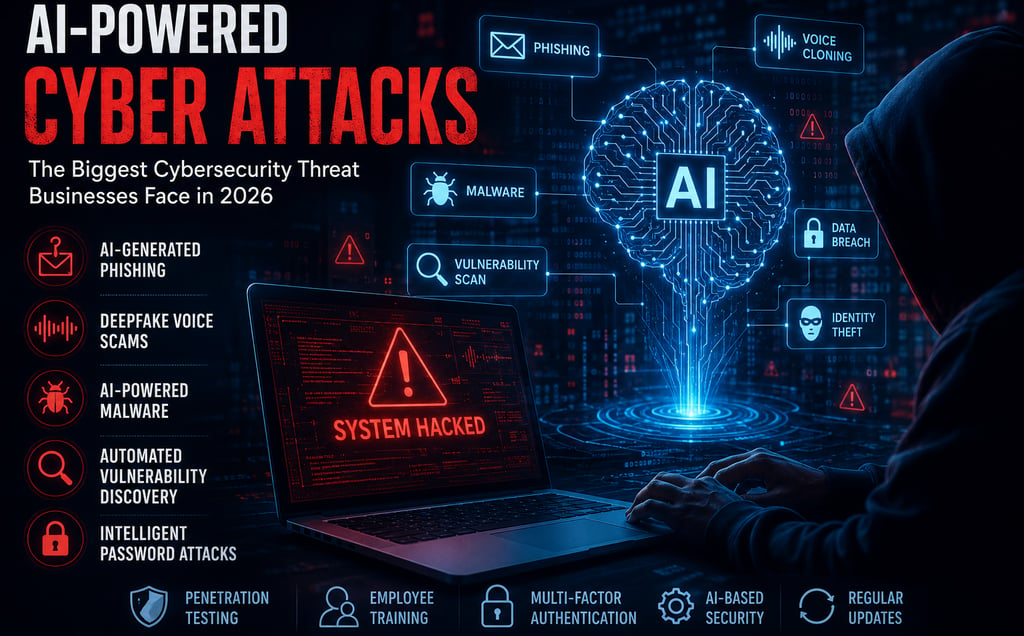

Artificial Intelligence (AI) is rapidly transforming the modern digital world, helping organizations automate operations, strengthen decision-making, and improve customer experiences. However, the same technology is also being weaponized by cybercriminals to launch more advanced, automated, and intelligent cyber attacks. In 2026, AI-powered cyber attacks have emerged as one of the most dangerous cybersecurity threats facing businesses globally. Attackers are now using artificial intelligence to automate phishing campaigns, bypass traditional security systems, identify vulnerabilities faster, and create highly convincing scams that are difficult to detect. As organizations continue to adopt cloud computing, remote work environments, and connected technologies, the attack surface for cybercriminals continues to expand, making cybersecurity more critical than ever before.
AI-powered cyber attacks refer to malicious activities where hackers use artificial intelligence and machine learning technologies to improve the speed, accuracy, and effectiveness of their attacks. Unlike traditional cyber attacks that require significant manual effort and technical expertise, AI-enabled attacks can automate large parts of the hacking process. These systems can quickly analyze huge amounts of data, mimic human behavior, adapt to security defenses in real time, and identify weaknesses within networks or applications. Because of this, modern cyber attacks are becoming increasingly sophisticated and difficult for conventional security tools to detect. Businesses relying solely on traditional antivirus software and outdated security practices are finding it harder to defend against these evolving threats.
One of the biggest reasons for the rise of AI-driven cyber attacks is the widespread availability of AI tools and automation frameworks. Open-source artificial intelligence platforms have made advanced technology accessible not only to businesses and developers but also to cybercriminals. Attackers no longer need deep technical knowledge to conduct complex attacks. They can use AI-based tools to automate reconnaissance, scan networks for vulnerabilities, generate convincing phishing emails, crack passwords, and even evade security detection systems. At the same time, the rapid digital transformation happening across industries has created more opportunities for hackers. Businesses are increasingly dependent on online platforms, cloud infrastructure, remote work systems, and interconnected devices, all of which create potential entry points for attackers.
AI-generated phishing attacks are among the most common and dangerous threats businesses face today. Traditional phishing emails were often easy to identify because of poor grammar, suspicious links, or generic messaging. However, AI has dramatically improved the quality and realism of phishing campaigns. Cybercriminals can now use AI to analyze publicly available information, mimic communication styles, personalize messages, and generate professional business emails that appear completely legitimate. Employees receiving these emails may struggle to distinguish between genuine communication and malicious attempts to steal sensitive information. In many cases, attackers impersonate company executives, financial departments, or trusted vendors to manipulate employees into transferring money or revealing login credentials.
Deepfake technology has also become a major cybersecurity concern. Using artificial intelligence, cybercriminals can create highly realistic fake videos and cloned voice recordings that impersonate real individuals. Businesses around the world have already experienced fraud cases where employees received calls that sounded exactly like their executives, instructing them to authorize financial transactions or share confidential information. Because the voices and videos appear authentic, victims often comply without suspecting malicious intent. Deepfake attacks are expected to become even more advanced as AI technology continues to evolve, posing serious risks to organizations, governments, and individuals alike.
Another growing threat is AI-powered malware. Modern malware integrated with artificial intelligence is capable of adapting its behavior based on the environment it infects. Unlike traditional malware that relies on static code signatures, AI-enabled malware can modify its code, learn from system responses, and avoid detection by antivirus solutions. Some advanced malware can identify valuable files, prioritize targets, and spread intelligently across networks without human intervention. This makes it significantly harder for organizations to detect infections early and respond before serious damage occurs. AI-powered malware represents a major shift in the cybersecurity landscape, where attackers increasingly rely on automation and intelligent decision-making rather than manual hacking techniques.
Cybercriminals are also using artificial intelligence to automate vulnerability discovery. AI systems can scan websites, cloud environments, applications, and networks much faster than traditional manual methods. These tools help attackers identify weak passwords, outdated software, exposed databases, insecure cloud configurations, and other vulnerabilities within minutes. Once weaknesses are discovered, attackers can quickly exploit them before businesses have an opportunity to apply security patches or remediation measures. The speed at which AI systems can identify vulnerabilities creates a significant challenge for organizations attempting to maintain secure environments.
Intelligent password attacks have become another major concern in modern cybersecurity. Artificial intelligence can analyze password patterns, leaked credentials, and user behavior to predict passwords more effectively than traditional brute-force methods. Machine learning algorithms help attackers generate more accurate password combinations based on common human habits and previously exposed data breaches. As a result, weak passwords and reused credentials continue to be one of the easiest ways for attackers to gain unauthorized access to business systems and sensitive information.
Businesses across nearly every industry are vulnerable to AI-powered cyber attacks, but certain sectors face particularly high risks. Financial institutions are frequent targets due to the potential for monetary theft and fraud. Healthcare organizations are attacked because medical records contain highly sensitive personal data valuable on the dark web. E-commerce businesses face risks related to payment fraud, account takeovers, and customer data breaches. Government agencies are often targeted for espionage, infrastructure disruption, and political manipulation. Small businesses are also increasingly becoming victims because they typically lack advanced cybersecurity defenses and dedicated security teams.
To protect against AI-driven cyber threats, businesses must adopt proactive cybersecurity strategies. One of the most effective methods is conducting regular penetration testing. Penetration testing helps organizations identify vulnerabilities before attackers can exploit them. During a penetration test, cybersecurity professionals simulate real-world attacks against systems, applications, and networks to evaluate their security posture. This process helps businesses discover weaknesses, improve defenses, validate security controls, and strengthen incident response capabilities. Regular penetration testing has become essential in today’s threat landscape, especially as attackers continue using AI to automate and accelerate cyber attacks.
Implementing multi-factor authentication (MFA) is another critical security measure. MFA adds an additional layer of protection by requiring users to verify their identity through multiple methods beyond just a password. Even if attackers successfully steal login credentials, MFA significantly reduces the likelihood of unauthorized access. Organizations should also invest in cybersecurity awareness training for employees, as human error remains one of the leading causes of security breaches. Employees should be educated about phishing scams, suspicious links, social engineering tactics, password security, and safe online practices to minimize the risk of successful attacks.
Modern businesses should also consider adopting AI-based cybersecurity solutions. Just as attackers are using artificial intelligence offensively, security teams can leverage AI defensively to improve threat detection and response. AI-powered security tools can monitor network activity in real time, identify unusual behavior patterns, automate threat analysis, and respond to incidents faster than manual methods. These technologies help organizations stay ahead of increasingly sophisticated cyber threats and reduce response times during security incidents.
Keeping systems updated remains one of the simplest yet most effective cybersecurity practices. Many successful cyber attacks exploit known vulnerabilities in outdated software and unsupported systems. Businesses should implement regular patch management processes to ensure operating systems, applications, and security tools are consistently updated with the latest security fixes. Removing unsupported software and addressing outdated infrastructure can significantly reduce the attack surface available to cybercriminals.
As artificial intelligence continues to evolve, both cyber attacks and cybersecurity defenses will become more advanced. Businesses can expect to see more automated attacks, sophisticated ransomware campaigns, realistic deepfake scams, and intelligent malware in the coming years. At the same time, cybersecurity technologies powered by AI will continue improving threat detection, automated defense mechanisms, and security monitoring capabilities. Organizations that fail to adapt to these changes may face severe financial losses, reputational damage, operational disruption, and legal consequences resulting from data breaches and cyber incidents.
In conclusion, AI-powered cyber attacks are reshaping the cybersecurity landscape in 2026. Cybercriminals are leveraging artificial intelligence to automate attacks, bypass traditional defenses, exploit vulnerabilities faster, and conduct highly convincing scams against businesses and individuals. As these threats continue to evolve, organizations must adopt proactive cybersecurity strategies that include regular penetration testing, employee awareness training, multi-factor authentication, modern security solutions, and continuous system updates. Cybersecurity is no longer optional in the digital age. Businesses that prioritize security and stay prepared for emerging threats will be better positioned to protect their systems, data, customers, and reputation in an increasingly connected world.