The Key Differences Between ISO 27001 and SOC 2
1. Certification vs. Audit Report
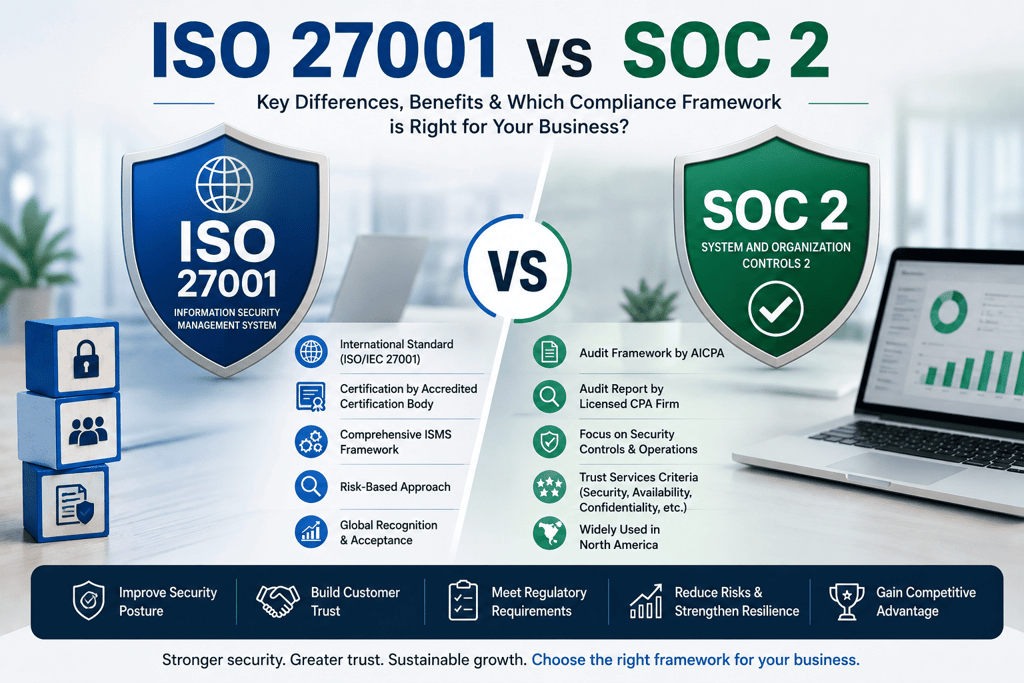
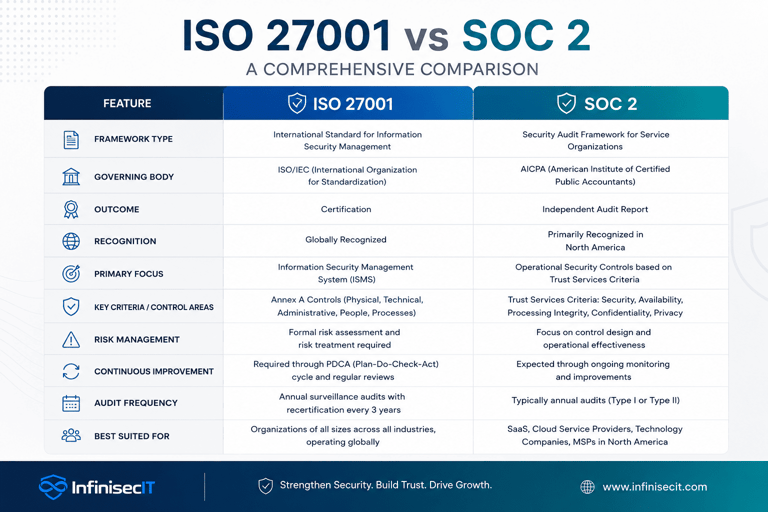
The most fundamental difference between ISO 27001 and SOC 2 lies in what organizations receive after successfully completing the assessment.
With ISO 27001, organizations earn an internationally recognized certification issued by an accredited certification body. This certification confirms that the organization has implemented an effective Information Security Management System that complies with the requirements of the standard.
With SOC 2, organizations receive an independent audit report prepared by a licensed CPA firm. Rather than certifying compliance, the report provides assurance to customers that the organization's security controls have been evaluated and found to be operating effectively.
2. Scope and Focus
ISO 27001 focuses on the management of information security across the entire organization. It emphasizes governance, risk management, security policies, leadership commitment, continual improvement, and the implementation of security controls.
SOC 2 focuses on evaluating operational security controls that protect customer data. The audit assesses how effectively these controls operate over time based on the selected Trust Services Criteria.
Simply put:
ISO 27001 evaluates how your security management system is designed and managed.
SOC 2 evaluates how your security controls perform in practice.
3. Risk Management
Risk management is at the heart of ISO 27001.
Organizations are required to:
Identify information assets
Assess threats and vulnerabilities
Evaluate business risks
Define risk treatment plans
Continuously review and improve controls
SOC 2 also considers risk management, but its primary emphasis is on demonstrating that security controls are effectively implemented and operating as intended.
4. Global Recognition
ISO 27001 is recognized and accepted worldwide. Organizations operating internationally often choose ISO 27001 because it demonstrates compliance with a globally respected information security standard.
SOC 2, on the other hand, is primarily recognized in North America. Enterprise customers in the United States frequently request SOC 2 reports during vendor risk assessments.
5. Control Framework
ISO 27001 includes a comprehensive set of security controls covering areas such as:
Information security policies
Asset management
Access control
Cryptography
Human resource security
Physical security
Supplier management
Incident management
Business continuity
Compliance management
SOC 2 evaluates controls related to:
Authentication
Authorization
Encryption
System monitoring
Logging
Vulnerability management
Backup and disaster recovery
Privacy protection
Data processing integrity
ISO 27001 Certification Process
Implementing ISO 27001 requires careful planning and organizational commitment. While every organization's journey is unique, the certification process generally follows these stages:
Gap Assessment
Organizations begin by assessing their existing security controls to identify gaps against ISO 27001 requirements.
Risk Assessment
A formal risk assessment is conducted to identify threats, vulnerabilities, and potential impacts on business operations.
ISMS Development
The organization establishes its Information Security Management System by creating policies, procedures, risk registers, asset inventories, and supporting documentation.
Control Implementation
Technical, administrative, and physical security controls are implemented to address identified risks.
Internal Audit
An internal audit verifies that the ISMS operates effectively and complies with the standard.
Management Review
Senior management evaluates the effectiveness of the ISMS and approves improvements before certification.
Certification Audit
An accredited certification body performs a two-stage audit to assess compliance with ISO 27001 requirements.
Continuous Improvement
Following certification, organizations undergo annual surveillance audits to maintain certification and continually improve their ISMS.
SOC 2 Audit Process
SOC 2 follows a different approach.
Organizations typically begin with a readiness assessment to identify gaps before implementing or strengthening security controls. Evidence such as system logs, access records, security policies, monitoring reports, and incident management documentation is then collected.
For SOC 2 Type II, controls are observed over a defined period—typically between three and twelve months—to demonstrate consistent operational effectiveness.
Finally, an independent CPA firm conducts the audit and issues a SOC 2 report that organizations can share with customers under appropriate confidentiality agreements.
Benefits of ISO 27001
Organizations that achieve ISO 27001 certification often experience benefits beyond compliance.
These include:
Improved cybersecurity maturity
Better risk management
Stronger governance
Increased customer confidence
Greater operational efficiency
Simplified regulatory compliance
Competitive differentiation in global markets
Enhanced business continuity and resilience
Benefits of SOC 2
SOC 2 offers significant value for organizations that provide cloud-based or technology services.
Key benefits include:
Increased customer trust
Faster enterprise sales cycles
Improved vendor qualification
Demonstrated operational security
Stronger internal security processes
Enhanced reputation in competitive markets
Which Framework Should Your Organization Choose?
The right choice depends on your business model, customer expectations, and strategic objectives.
Choose ISO 27001 if:
Your organization operates internationally.
You require globally recognized certification.
You want a comprehensive Information Security Management System.
Regulatory compliance is a priority.
You want to build a mature, long-term security program.
Choose SOC 2 if:
You primarily serve customers in North America.
You are a SaaS or cloud service provider.
Enterprise customers request SOC 2 reports during vendor assessments.
You want to demonstrate operational effectiveness of security controls.
Consider Both if:
Many organizations pursue both ISO 27001 and SOC 2 because they complement one another.
ISO 27001 establishes the governance, risk management, and security framework, while SOC 2 provides independent assurance that security controls operate effectively.
Organizations holding both certifications often enjoy increased customer confidence, shorter procurement cycles, and a stronger competitive position.
Common Challenges During Implementation
Implementing either framework requires planning, resources, and executive support.
Organizations commonly encounter challenges such as:
Incomplete security documentation
Lack of defined policies and procedures
Limited employee security awareness
Poor asset management
Weak access control processes
Inadequate risk management
Insufficient evidence collection
Limited security monitoring
Working with experienced cybersecurity and compliance professionals can significantly simplify implementation and improve audit readiness.
Best Practices for a Successful Compliance Journey
Organizations should view compliance as an ongoing process rather than a one-time project.
Successful implementations typically include:
Executive leadership commitment
Clearly defined security governance
Regular risk assessments
Comprehensive employee awareness training
Strong identity and access management
Continuous monitoring and vulnerability management
Routine internal audits
Periodic testing of incident response and business continuity plans
Continuous review and improvement of security controls
Conclusion
As cyber threats continue to evolve and customers demand greater transparency, demonstrating a strong commitment to information security has become essential for organizations of all sizes.
ISO 27001 and SOC 2 are both highly respected frameworks, but they serve different purposes. ISO 27001 provides a globally recognized certification built around a comprehensive Information Security Management System, while SOC 2 offers independent validation that an organization's security controls are designed and operating effectively.
Choosing the right framework depends on your organization's industry, customer requirements, geographic presence, and long-term security strategy. For many businesses—particularly technology companies, SaaS providers, managed service providers, and organizations handling sensitive data—implementing both ISO 27001 and SOC 2 creates a strong foundation for security, compliance, and customer trust.
At InfinisecIT, we help organizations navigate every stage of their compliance journey—from gap assessments and policy development to audit readiness and certification support. Whether you're preparing for ISO 27001 certification, pursuing SOC 2 compliance, or strengthening your overall cybersecurity posture, our experts can help you achieve compliance efficiently and confidently